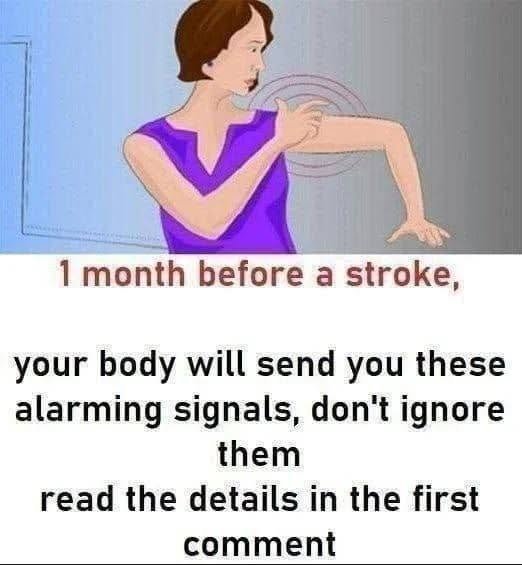
While major strokes typically strike suddenly, research indicates that a significant number of patients experience subtle warning signs or **Transient Ischemic Attacks (TIAs)**—often called “mini-strokes”—in the weeks or even a month leading up to a major event.
Recognizing these early indicators can provide a critical window for medical intervention.
—
### Potential Early Warning Signs (Weeks to a Month Before)
Some individuals report recurring, minor neurological symptoms in the days or weeks leading up to a stroke. These can be easily dismissed, but they warrant medical evaluation:
* **Transient Numbness or Weakness:** Brief episodes of tingling, heaviness, or mild weakness, typically restricted to one side of the face, arm, or leg.
* **Unexplained Vision Changes:** Brief spells of blurred vision, double vision, or temporary loss of sight in one eye.
* **Subtle Speech Difficulties:** Minor, temporary trouble finding words, slurring, or feeling as though language is harder to process.
* **Dizziness and Balance Issues:** Unexplained episodes of vertigo, unsteadiness, or feeling lightheaded.
* **New, Severe Headaches:** Unusually intense or frequent headaches that do not have a clear cause and do not respond well to standard pain relief.
—
### The Critical Precursor: Transient Ischemic Attack (TIA)
Many “early warnings” a month or days prior are actually **TIAs**. A TIA happens when blood flow to a part of the brain is temporarily blocked.
* **The Catch:** TIA symptoms mimic a full stroke—such as sudden facial drooping, arm weakness, or speech difficulty—but **resolve completely within a few minutes to hours**.
* **Why It Matters:** Because the symptoms disappear, people often ignore them. However, a TIA is a major red flag: roughly 1 in 3 people who experience a TIA will go on to have a full stroke, frequently within a year (and highest risk is often in the immediate days and weeks following).
—
### How to Recognize an Active Stroke: B.E. F.A.S.T.
While subtle signs can appear weeks in advance, an actual stroke requires immediate emergency care. Use the **B.E. F.A.S.T.** acronym to spot the signs:
* **B – Balance:** Sudden loss of balance or coordination.
* **E – Eyes:** Sudden trouble seeing in one or both eyes.
* **F – Face Drooping:** Does one side of the face droop, or is it numb?
* **A – Arm Weakness:** Is one arm weak or numb? If the person tries to raise both, does one drift downward?
* **S – Speech Difficulty:** Is speech slurred, are they unable to speak, or hard to understand?
* **T – Time to call emergency services:** If you observe any of these signs, call your local emergency number immediately—even if the symptoms go away.
*Note: If you or someone you know has experienced brief, stroke-like symptoms recently—even if they resolved quickly—it is crucial to consult a healthcare provider or neurologist right away for diagnostic testing (such as brain imaging or vascular checks) to prevent a major stroke.*